
Frequently Asked Questions
Filter by tag:
What is the proposed Heath Hills subdivision?
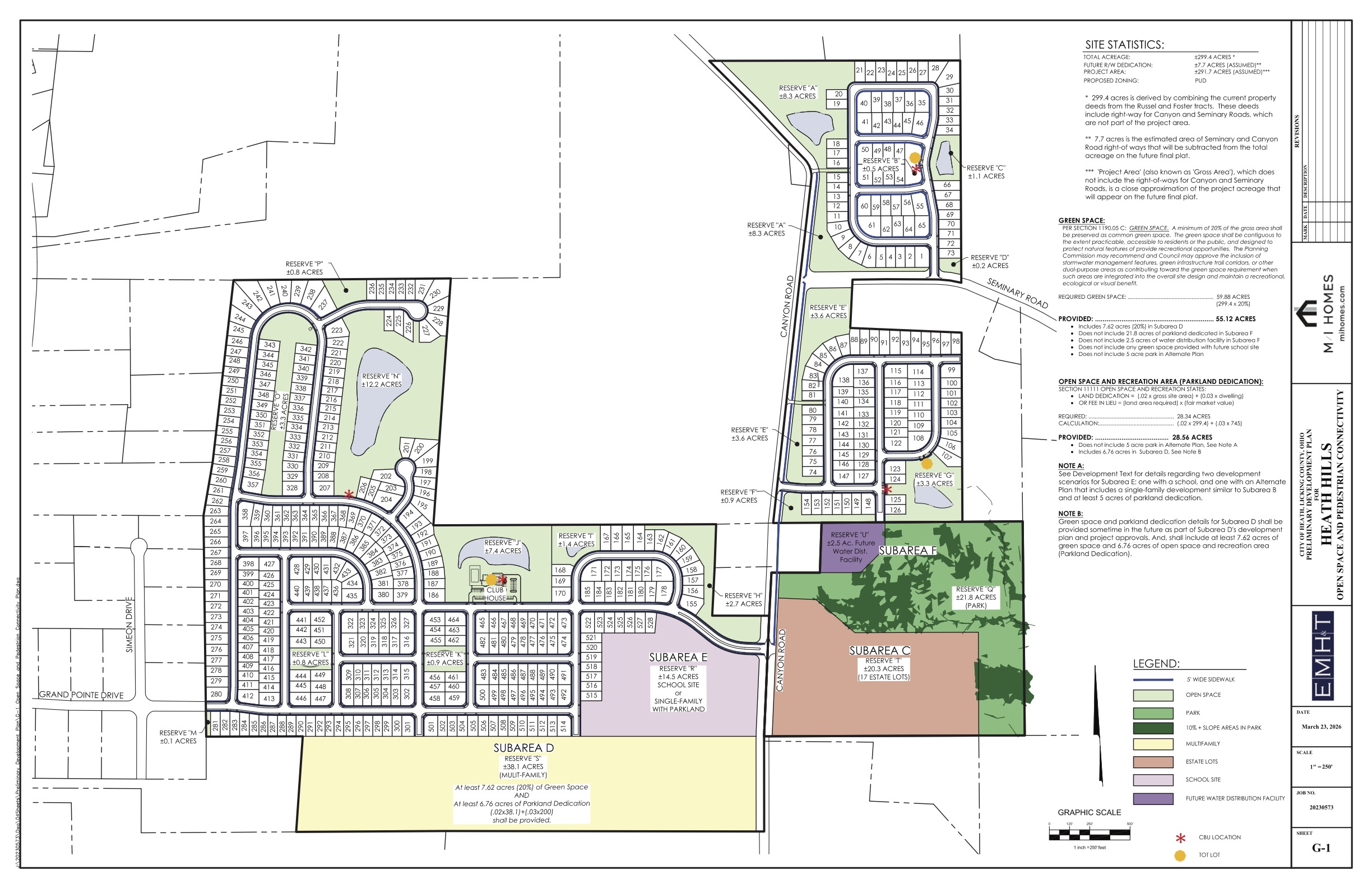
Heath Hills is a large-scale residential development proposed by M/I Homes of Columbus on 212.61 acres of farmland annexed into the City of Heath from Union Township (two parcels). The July 13, 2026 draft agreement sets the project at 504 homes on paper — 546 in practice (minimum lot size 7,145 sq ft, ~⅙ acre), with prices expected to range from around $550,000 to $800,000, along with a swimming pool and clubhouse. The “cap” depends on Granville building a school it cannot afford; when the school site reverts, up to 42 more homes take its place.
The draft also offers Granville a 17.1-acre school site for a K-5/K-6 elementary school — but only if the district funds and starts construction on M/I's deadline (notice after the 326th home; 365 days to start). Granville has no such bond; if it fails, the land automatically becomes up to 42 more homes instead of a school. While the development is in Heath, all homes fall within the Granville Exempted Village School District boundaries.
Construction is expected to proceed at a pace of 70–80 homes per year over roughly 8–10 years.
Where is Heath Hills located and why does it affect Granville?
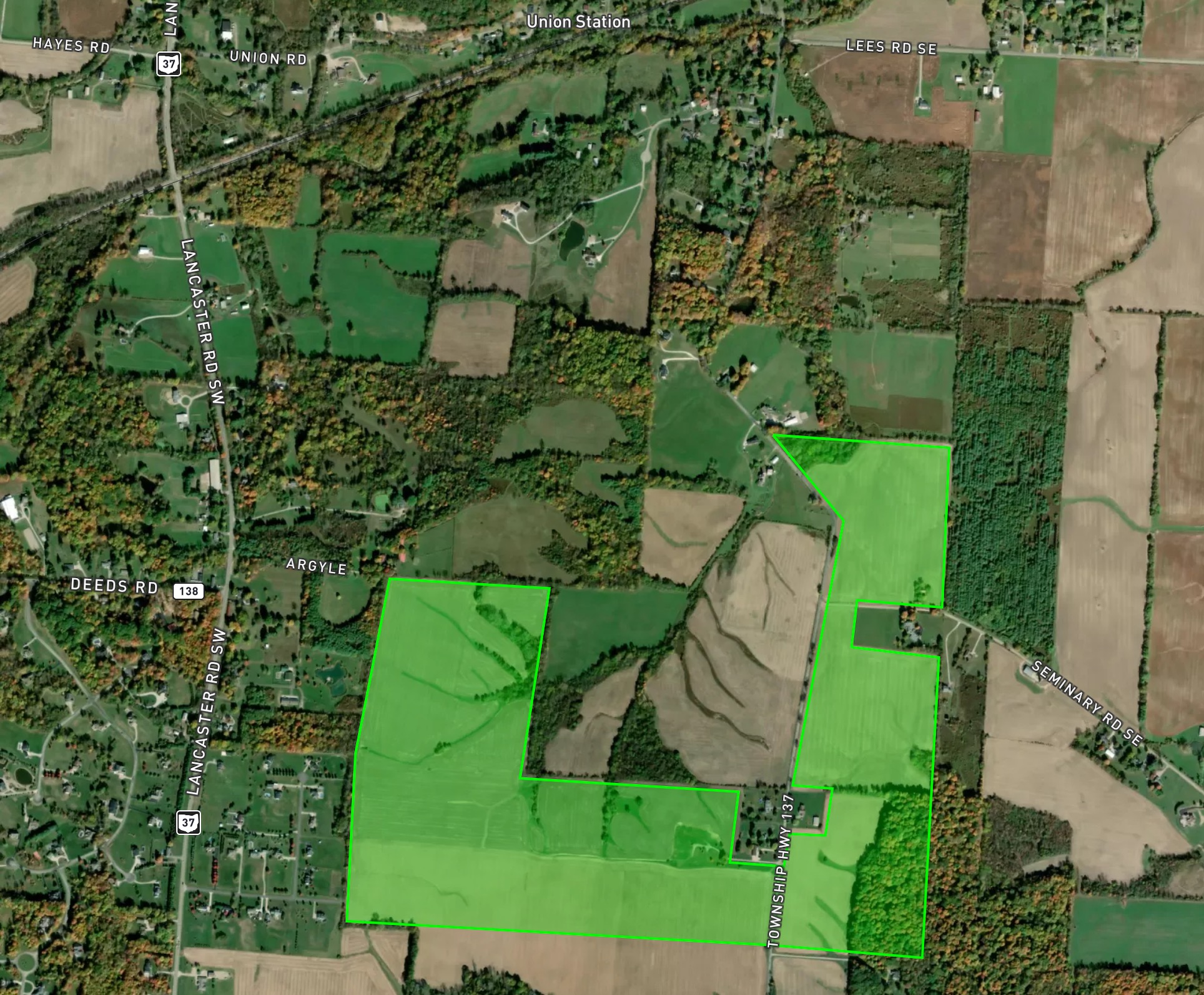
The subdivision is located south of Granville along the east side of Rt. 37, around the intersection of Seminary Road and Canyon Road. Although the land is now part of the City of Heath, it remains entirely within the Granville school district.
This creates a classic mismatch: Heath gains tax revenue, development fees, and economic benefits, while Granville schools must absorb all the new students and associated costs with no ability to control the project or adjust density to a model that would fit with the community.
How many homes and what density is proposed?
The July 13, 2026 draft agreement sets the project at 504 homes on paper, 546 in practice (minimum lot size 7,145 sq. ft., roughly ⅙ acre) — the zoning allows 528. The “cap” depends on Granville building a school it cannot afford; when the 17.1-acre school site reverts to M/I Homes, up to 42 more homes take its place. Density is about 3 units per acre — dramatically higher than surrounding areas and the sustainable model this region was built on.
Granville township and Union Township typically allow 1 home per 5 acres, or as little as 2 acres in a planned development with green space. The adjacent Grand Pointe subdivision has 1 home per 2 acres.
M/I Homes has stated that 3 units per acre is its firm limit. Critics note this density still maximizes financial impact on Granville schools while doing little to address affordability — these are $550,000–$800,000 homes on small lots.
How many new students will it add to Granville schools?
The Granville Schools hired an independent enrollment consultant (Wolpert Inc./Cooperative Strategies) to analyse the likely growth in students. Using analytical models based on past housing growth in Granville, they created an accurate model of expected enrollment growth. The model predicts a peak average number of students per house of 1.6. Plan on 546 homes: this development alone is projected to add an estimated ~874 new students to Granville's current enrollment of roughly 2,500–2,600 students — a ~35% increase. The “504-home cap” only applies if Granville builds a school it can't afford; at 504 homes the central estimate is ~806 (~32%). The earlier "840–1,000" range was derived from the pre-cap home counts and is shown here labeled by scenario.
Superintendent Jeff Brown's working estimate (based on earlier counts) was approximately 840–850 students (a 33% increase), with the independent consultant projecting up to 960–1,000 at the pre-cap build-out. At the 546-home planning figure the central estimate is ~874; at 504 homes (conditional on a school being built) ~806. Either figure represents a generational disruption to the district.
Granville Elementary and Intermediate schools are already operating at or near 95% capacity. Without significant new construction, the district will quickly need modular classrooms or other temporary solutions, with long-term needs for enormous capital investments for additional buildings at all levels.
What are the estimated costs to Granville schools and taxpayers?
The district projects an additional $12 million per year in operating costs for these new students once fully built out, plus up to $55 million in capital costs for new and expanded facilities. State funding does not increase with enrollment growth or cover new construction in this scenario. Unlike other districts in Licking County, the state also does not support new building construction for Granville Schools.
The July 13 draft adds new school-side revenue: "Additional School Payments" of 2.25 mills for 20 years (plus 1 mill for 15 years if the new elementary school opens) per NEW-DA §11(c). But including those payments, the funded share of new operating costs rises only about 2–3 percentage points — the gap is essentially unchanged. Even with them, at the 546-home planning figure this shortfall will require major local property tax increases of about 14.71 mills (10.66 mills operating + 4.05 mills for new buildings, per the /financials calculator at the 546-home default, which includes the 2.25-mill Additional School Payments). Estimates suggest over $2,300 on average per household annually — roughly a 30% property tax hike for existing Granville property owners, severely impacting seniors, long-term residents, and families on fixed incomes. Lower density or a different home product mix would significantly lower the tax burden. The Additional School Payments run 15–20 years while the operating costs are permanent, and the 1-mill portion is contingent on a school opening.
Visit the Financials page for a detailed breakdown.
Why was Heath Mayor Mark Johns named BIA of Central Ohio Citizen of the Year?
The Building Industry Association (BIA) of Central Ohio is the trade group representing home builders and developers in the region, including M/I Homes. Each year at their "Big Night" gala they present a Citizen of the Year award to a non-BIA member who has provided "major benefits to the community and the building industry."
In 2025 Mayor Mark Johns received this award. The timing coincides with his strong public support for M/I Homes' proposed Heath Hills subdivision — a project that would deliver significant new housing units to Columbus builders.
Questions have been raised about what specific service to the builders earned the mayor this recognition, especially given his defense of the project's high density despite strong objections from Granville schools and residents. The award highlights the close relationship between local elected officials and the development industry at a time when critical zoning decisions for Heath Hills were pending before Heath City Council.



Won't new tax revenue from the subdivision cover Granville's increased education costs?
No. At the 546-home planning figure and using the /financials calculator as the single sitewide source of truth (F-3), new homes are estimated to generate about $3.7 million annually in property tax, income tax, and the July draft's 2.25-mill "Additional School Payments" for Granville schools — far short of the over $12 million in added operating expenses. Including the new payments, the funded share of new operating costs rises only about 2–3 percentage points. (A separate, smaller figure appears on the /tif page because that model uses a $600k home value and shows only the schools' pre-Additional-Payments share; the /financials figure is the canonical one.)
The gap is structural: Ohio's school funding formula locks Granville's state aid at 2020 enrollment levels. Every additional student that arrives from Heath Hills comes with no additional state dollars — the full cost falls on local Granville taxpayers. The 1-mill contingent portion of the new school payments only materializes if the new elementary school actually opens, and even the full 2.25 + 1 mills run only 15–20 years while operating costs are permanent.
Visit the Financials page for a detailed breakdown of the revenue gap.
What is the TIF, and why should Heath and Granville residents care?
A Tax Increment Financing (TIF) district is a financing tool that diverts future property tax growth — the "increment" created by new development — away from normal taxing entities and into a special fund controlled by the city. The July 13, 2026 draft development agreement between Heath and M/I Homes requires the city to create TIF districts covering the entire Heath Hills site for 30 years, at 100% exemption.
Here's how it works in practice: once Heath Hills homes are built and their property values rise, the resulting tax increment is captured into a TIF fund. Instead of flowing to county services, parks, libraries, and other taxing entities, that revenue is used to pay off the city's own public infrastructure debt — and once that is repaid, the rest flows to Heath's General Fund "for any lawful purpose" (NEW-DA §11(a)(iv)). The May draft's $6M / 7% developer reimbursement is gone from the July draft — roads are now the developer's sole cost (§7(b)).
The city's own financial plan (Baker Tilly, presented publicly July 13) shows Heath borrowing ~$20.2 million in 5-year notes (dated 12/1/2027), refunded by ~$20.1 million in 35-year general obligation bonds maturing 12/1/2067 — $43.4M in total debt service. Because the bonds are general obligation, Heath's general fund and income-tax revenues are pledged if TIF/NCA revenues fall short (projected ~1.32x coverage through 2067).
The agreement also specifies that school districts receive "compensation payments" equal to what they would have received without the TIF — meaning Granville Schools is held harmless on the TIF itself (§11(a)(i)). The July draft adds "Additional School Payments" to Granville EVSD: 2.25 mills for 20 years per parcel, plus 1 mill for 15 years if the new elementary school opens on time (§11(c)). In practice that's roughly $240,000/yr at full buildout — about 2% of the ~$12M/yr operating gap from ~874 new students at 546 homes. The payments are "intent" language at Heath's discretion (Heath controls the NCA money "in the City's sole discretion," §11(b)), run only 15–20 years while operating costs are permanent, and the 1-mill portion is contingent on a school opening. Those costs still fall entirely on Granville taxpayers.
What gets squeezed out? During the 30-year TIF period, the tax increment that would otherwise flow to Licking County general services, parks such as Indian Mound Metro Park (located directly adjacent to the development site), and other county-wide functions is instead diverted to repay Heath's infrastructure debt and then to its General Fund. That's a significant, multi-decade transfer of public value to the city — and county services stay frozen at today's farmland baseline the entire time.
In addition, a New Community Authority (NCA) charge of up to 7.5 mills on every Heath Hills homeowner will fund "community facilities" — fees paid to the city, starting only after subdivision and occupancy (§11(b)).
The TIF and NCA structure is how the city plans to fund its commitments. Residents in both Heath and Granville deserve to understand this arrangement — which is why any discussion of the project's finances should be held in public, not in closed executive sessions. See the full interactive TIF breakdown → See the question below about executive sessions.
What is the executive session, and why was it a problem?
At the June 15, 2026 council meeting, Mayor Johns announced that the Heath City Council Finance Committee would meet on June 29 in "executive session" — a closed, non-public meeting — to discuss the project's finances and "development agreements."
Ohio's Open Meetings Act generally requires government bodies to deliberate in public. Executive sessions are permitted only for specific, narrow purposes defined by state law — such as personnel matters, pending litigation, or the purchase of real estate. Discussing the financial terms of a proposed zoning and development agreement with a private developer does not obviously fit any of those exemptions.
Granville resident Thomas Miller, a former school board member, raised this concern directly at the meeting, questioning whether the council has legal authority to hold this discussion behind closed doors.
What happened: the June 29 executive session did not result in a binding private vote on the agreement's finances. Instead, the revised draft development agreement and the city's full financing plan (the Baker Tilly financial summary) were ultimately presented publicly at the July 13, 2026 Community Development & Zoning Committee meeting — the right outcome, and a direct result of residents demanding transparency.
That matters for everyone: the development agreement reveals a complex TIF and financing structure that will affect tax revenue, infrastructure spending, and county-wide cash flows for 30 years (with Heath's GO bonds running to 2067). When such terms are debated in the open, the public — in both Heath and Granville — can weigh in before a binding commitment is made.
What you can do: Contact Heath City Council and respectfully ask that any future discussion of the development agreement's financial terms be held in an open public meeting. Learn more about the TIF.
Why is the high housing density so controversial?
The proposed density maximizes homes (and therefore students) on the land, creating an overwhelming burden on Granville schools and infrastructure. It directly contradicts the collaborative FRAMEWORK regional growth plan that Heath and Granville officials previously supported to avoid exactly this kind of development.
Granville officials have described it as "grotesque exploitation" of Granville's high-quality schools and taxpayers for the benefit of Heath and the developer. It turns Granville schools into the primary selling point for a Heath subdivision while shifting all costs to Granville residents.
What is Ohio Senate Bill 173 (SB 173) and why does it matter here?
SB 173 is legislation introduced in 2025 that would reform how school district boundaries are handled when a city annexes land. It would make it easier in certain cases (especially large "megaproject" developments) for school district lines to automatically transfer with the annexed territory — so the annexing city's school district would serve the new residents.
Granville officials have strongly supported the principles behind SB 173 because it would prevent situations like Heath Hills, where Heath controls zoning and collects taxes but Granville bears the full cost of educating nearly 1,000 additional students. Without such reform, the current system allows exactly this kind of cost-shifting.
How does Ohio's school funding system affect this project?
Because Granville is on a state funding guarantee, it will receive zero additional dollars from the state for these new students. If these students were added to other school districts, the state would provide additional funding. The gap between the ~$3.7 million in new local taxes and Additional School Payments (per the /financials calculator at the 546-home planning figure) and the $12 million in projected operating costs — plus up to $55M in capital costs — would likely require significant tax increases (about 14.71 mills) for all current Granville School District residents. Including the new payments, the funded share of new operating costs rises only about 2–3 percentage points. The July draft's 2.25-mill Additional School Payments narrow that gap only slightly and run just 15–20 years against permanent operating costs.
What other impacts will the subdivision have on traffic, infrastructure, and the community?
Major concerns include severe congestion and safety issues on already-challenged Rt. 37 and local roads through the existing neighborhoods like Grand Pointe, and Canyon and Seminary roads. The July 13 draft agreement requires a three-way stop at Seminary & Canyon now, and M/I Homes only dedicates right-of-way for a possible future roundabout (NEW-DA §4–5) — it is not a committed improvement. M/I Homes does fund Canyon/Seminary widening (11-foot travel lanes, 3-foot shoulders) at its sole cost, but only on a timeline tied to construction phases, meaning traffic impact arrives well before the improvements do. The initial widening is due within 1 year of first occupancy; Phase 3 triggers widening to the northern city limit; the developer maintains existing roads until city acceptance (§4).
The proposal requires 12 zoning deviations. Residents fear loss of farmland, reduced property values if schools become overcrowded or underfunded, and long-term pressure on Granville's quality of life and tax base.
What have the developer and Heath mayor said, and what is the full picture?
M/I Homes states the proposed density of 3 units per acre is "as low as the company can go." Heath Mayor Mark Johns has defended the project, arguing it meets housing demand. The July 13 draft agreement offers Granville a 17.1-acre school site for a K-5/K-6 elementary school (with a construction deadline and an automatic reverter to M/I Homes — up to 42 more homes — if Granville doesn't build on time), and directs "Additional School Payments" to Granville Schools: 2.25 mills for 20 years, plus 1 mill for 15 years if the new school opens on time (NEW-DA §3, §11(c)) — worth ~2% of the projected school shortfall, and contingent on Granville building a school it can't afford. The project is set at 504 homes on paper, 546 in practice. The May draft's $6M / 7% developer reimbursement is gone from the July draft.
However, these statements do not fully address the core imbalance: Granville bears nearly all education costs and student impact while receiving far less revenue. The mayor previously collaborated on the FRAMEWORK plan precisely to prevent developments that "bulldoze over" neighboring school districts. Learn more about the TIF.
What can Heath City Council members and local residents do now?
The Heath City Council vote is now scheduled for August 3, 2026. Council still has full approval authority, and several members have already said publicly they cannot support the project unless outstanding cost and transparency questions are resolved.
Council can:
- Vote no on the current terms, or require that any discussion of the development agreement be held in a public meeting, not a closed executive session
- Demand a full public cost-benefit analysis of the 30-year county-services diversion — including the TIF structure — before any vote
- Demand answers on the general-fund pledge behind the $20.1M / 35-year GO bonds and the projected ~1.32x coverage assumption [FIN] — and why the city is comfortable taking on 35-year debt against a 30-year TIF
- Demand a binding (not "intent") school-funding commitment and protection against the school-site reverter adding up to 42 more homes if Granville doesn't build the elementary school on time
- Require release of all traffic, utility-capacity, and public-safety studies
- Remand the project to planning to consider lower-density alternatives
- Reject the proposal outright (note: because the Planning Commission already approved it, rejection requires a super-majority of 5 of the 7 council members)
Residents of both Heath and Granville can
What changed in the July 13 draft development agreement?
A revised draft development agreement (dated 7/13/26) and the city's first public financing plan were released at the July 13, 2026 Community Development & Zoning Committee meeting. Here is what each change says — and what it actually does:
| What it says | What it does |
|---|---|
| “504-home maximum” — a hard cap, down from 528. [§3] | 546 unless Granville funds and builds a school on M/I's deadline. Granville has no such bond — so plan on 546, and the “cap” is conditional. |
| “Free 17.1-acre school land” donated to Granville EVSD. [§3] | A deadline and reverter: after the 326th home, Granville has 365 days to start a school it must fund itself (~$30M+ bond) — or the land reverts to M/I Homes as up to 42 more homes. It's a threat (build at your own expense, or get more students), not a gift. |
| “2.25 + 1 mills for schools” — Additional School Payments for 20 (+15) years. [§11(c)] | ~$240,000/yr at full buildout — about 2% of the ~$12M/yr operating gap — written as revocable “intent” paid from NCA charges Heath controls “in the City's sole discretion.” The 1 mill only exists if the school Granville can't fund gets built anyway. Temporary where the costs are permanent. |
| “$6M developer reimbursement removed” — roads are the developer's sole cost. [§7(b)] | Nothing to fund Granville's $12M/yr gap — the clause to watch is what replaced it (above), not what was deleted. The same draft added the head-fake clauses above. |
| Heath's bond plan is public. ~$20.2M notes refunded by ~$20.1M 35-yr GO bonds to 2067; $43.4M total, backed by Heath's general fund. [FIN] | Exposes Heath's own taxpayers: 35-year debt against a 30-year TIF, with the general fund / income tax pledged if the ~1.32x coverage falls short. |
| UNCHANGED: 30-yr / 100% TIF, schools held harmless on the TIF, NCA up to 7.5 mills, $11,120/lot utility prepayment, developer-funded road widening. [§11] | The core 30-year diversion from county services and the structural school-funding imbalance are untouched. |
Sources: July 13, 2026 draft agreement, Baker Tilly financial summary, City summary deck. See the updated TIF analysis.
Have a question not answered here?
Send us a message and we will get back to you as soon as possible.